
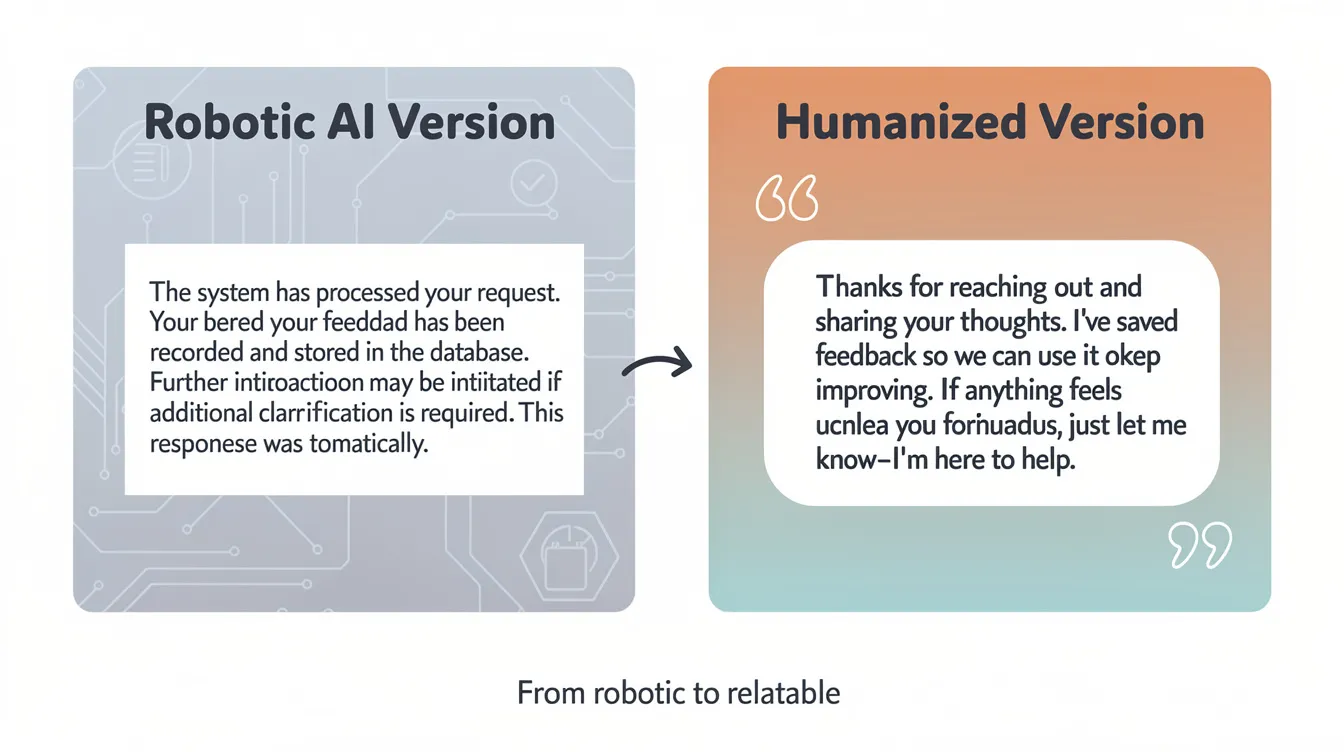
A humanizer is a tool or process that rewrites AI-generated text so it reads like natural human writing. In plain terms, the AI humanizer takes a stiff, predictable AI draft and varies the rhythm, word choice, and flow until it sounds like a person wrote it, all while keeping your original meaning intact.
You paste a paragraph from ChatGPT, read it back, and something feels off. The grammar is clean. The facts are clean. It still reads like a form letter from a robot. That gap, between correct writing and writing like yours, is why humanizers exist. This piece covers what the word means and what an AI humanizer does. For the click-by-click steps, see our guide on how to humanize AI text. Here we stay on the meaning.
What a humanizer is, in plain terms
Two different things wear the same name. A humanizer can be a piece of software, an AI humanizer tool you paste text into and click a button. It can also be the humanization process itself: the edits, by hand or machine, that turn AI phrasing into human writing. Same word, two meanings.
When people say AI humanizer or AI humanizers, they mean the tool. When they say AI humanization, they mean the process. The free AI humanizer people search for is the tool again, filtered by budget. All of it circles one idea: take AI text, make it sound human. An AI humanizer is really a shortcut for creating human-like writing out of a machine draft.
Tool or process, which one do you actually need?
Rewrite a few lines yourself and you have run the humanization process with no tool involved. Most people reach for an AI humanizer because doing it well, sentence after sentence, eats your afternoon. A good AI humanizer tool automates the boring part: spotting robotic phrasing, swapping the words a model overuses, and reshaping sentences to make the writing sound human.
Why humanize AI content at all
AI drafts have a tell: even sharp ones lean on the same shapes and three-beat rhythm. Readers clock it, sometimes without knowing why, and a uniform draft is a telltale sign of AI. Humanized AI text fixes that rhythm so your message lands, and a flat draft comes back to life.
There is a quality angle too. Smooth a draft into human-like writing and you reread it, which catches the weak logic AI loves to bury. So humanization nudges up your content quality. Skip it, and you ship AI content that reads fine on the surface and hollow underneath. Fine is not the same as engaging.
Who needs AI humanization
Short answer: anyone whose name goes on the writing.
Business professionals and teams
Business professionals live in email, decks, and reports. A humanizer speeds up creating those without the line-by-line editing, turning a rushed draft into something sendable. Think marketing copy that matches your brand voice, or AI-generated reports polished before a client sees them. It keeps you saving time and, when writing is your bottleneck, money. The tone stays yours.
Students, writers, and support desks
Students hand in essays where voice matters as much as facts, and essays that read naturally read like the student wrote them. Content writers publish for search engines that reward writing which reads naturally over writing that looks mass-produced. Support teams reply to real humans who smell a canned answer. All of them want the same from AI-assisted drafts: keep the substance, lose the stiffness.
How AI humanizers work: the humanization process
Under the hood, most humanizers move through three rough stages.
Reading your text first
The AI humanizer parses the input the user pasted, mapping structure, spotting repetition, and reading the context. It flags the phrases that scream AI.
Rewriting the patterns
Then it rewrites. This stage rewrites AI generated text into something varied: short sentences next to long ones, a swapped verb, a broken-up run-on. The result keeps your points and drops the monotony, so a humanized draft reads natural, with a human-like flow.
Matching the tone
Last, it aims the result at your audience. A casual post and a formal proposal need different registers, so a decent AI humanizer lets you steer the tone. Aim to sound natural for the specific reader, not natural in the abstract.
Common humanization techniques
The moves are less mysterious than they sound. When you are creating, vary sentence length so the writing has a pulse. Drop a colloquial phrase where a stiff one sat. Swap the AI vocabulary that repeats, choosing fresher words than a model defaults to. Cut the filler AI leans on. Done right, these edits turn human-like text out of a machine draft. Done lazily, they shuffle words around and call it natural.
How to use a humanizer: paste, click humanize, edit
Paste your AI text into the input box. Pick a style and how heavy a rewrite you want. Click humanize, and let the AI humanizer generate a humanized draft. Then, the step most users skip: do a quick editing pass and read the output yourself.
That last step is where you, the user, feel confident the piece is yours. For the best results, treat the humanized version as a strong draft, not a finished page. Adjust a sentence, restore a fact the rewrite bruised, keep the rest. You can try Eliten’s AI Humanizer and watch the process run on your own text in seconds.
Freemium options and quick trials
You will see the phrase free AI humanizer everywhere, because the market is full of free and freemium options. Free tiers are handy for a test run: paste a draft you are creating, humanize it, and see if the humanized text earns a spot in your workflow. Read the fine print on any free tool, since some cap length or reuse your words. A free credit to try a humanizer costs nothing and shows the quality before you sign up for more.
Use cases for humanized content
Marketing copy gets a brand voice instead of a beige one. Proposals and reports read like a person, not a spreadsheet. Blog posts hold attention, and a humanized version stays readable. Social captions stop sounding like a press release. Whatever you are creating, a humanized draft keeps the message engaging for the user who reads it. Across content creation, the thread is the same: AI wrote the first pass, a human shaped the second into humanized AI text, and the reader meets only that. That is humanized AI text doing its quiet job.
Humanizing writing across languages
AI writing is not an English-only problem. The same flat patterns show up in other languages too. A humanizer built for multiple languages can smooth a draft in Spanish, French, German, or Portuguese, not just English. If you write in two or three languages a week, that matters.
The catch: quality varies a lot between languages. A tool might nail English and French while stumbling in a language with thinner training data. So test your own languages before you trust the output, and treat a French or Spanish result like any first draft: something to check, not ship blind.
The honest part: detection, ethics, and academic integrity
Do humanized text and AI detectors get along?
Uncomfortable truth: AI detectors are shaky to begin with. OpenAI retired its own AI Text Classifier in July 2023 because it was too inaccurate to keep running. A Stanford team found that popular GPT detectors routinely flag writing by non-native English speakers as AI, even when a person wrote every word.
Chasing a green “human” score is chasing a moving target. Humanized text can reduce the signals detectors and plagiarism checkers lean on: repetitive structure, uniform sentence length, predictable word choice. It cannot guarantee any verdict, and no honest tool promises it can.
A note on academic integrity
A humanizer is a writing aid, not a shortcut around the rules. If you are a student or write in a regulated field, check what your school or employer allows, and be upfront about where AI helped. Use a humanizer to make your own ideas read clearly, not to pass someone else’s work as yours or to dodge disclosure. In education especially, transparency beats a clever workaround. Humanized AI text still needs your judgment on top.
What a humanizer can’t do
A tool that promises everything is lying. A humanizer will not fix a bad argument; it dresses up whatever logic you feed it. Cheap ones inject nonsense, mangling a clean line into word salad. A heavy rewrite can nudge your original meaning off course, which is why you reread and keep the focus on what you meant. It cannot manufacture ideas you did not have. The thinking stays your job; the AI humanizer handles the polish.
Picking an AI humanizer tool
Does the output read like human written text, or just reshuffled AI? Does it keep your original text’s meaning? How fast is it, and what happens to your data afterward?
Comparing tools before you commit
Privacy matters when you feed a tool client work or coursework, so keep your focus there. Demo two or three humanizers, run the same few hundred words through each, and compare. Every user’s own eyes are the real benchmark for turning AI text into human text you would put your name on.
Frequently asked questions
What does it mean to humanize something?
To humanize something is to give it human qualities or make it relatable, per Merriam-Webster. In AI writing, humanizing a draft means rewriting machine output so it reads natural, the way a person would say it.
What does it mean to humanize someone?
Humanizing a person means portraying them in a way that emphasizes their humanity and individuality, so an audience sees a real human rather than a statistic or a stereotype. Journalists, doctors, and advocates use the word this way, outside the world of AI text.
What is a better word for humanize?
It depends on context. For people, “personalize” or “make relatable” fit. For machine writing, “naturalize” or “rewrite to sound natural” captures the idea.
What is the meaning of womanizer in English?
Different word entirely. A womanizer is a man who habitually pursues casual relationships with women. It rhymes with humanizer and trips up autocomplete, but has nothing to do with AI writing or humanized text.
Does a humanizer change my original meaning?
It should not, and a good one does not. The goal is to change how the text sounds, not what it says. Heavier rewrites carry more risk, so read the humanized text once and confirm your facts and intent survived. Originality of thought stays with you.
Is my text private when I humanize it?
That depends on the tool, so read the privacy policy before you drop anything sensitive in. With Eliten, your text is not permanently stored or used to train models, the standard you should hold any humanizer to.
Correct AI writing and human writing are not the same thing, and now you know exactly which gap a humanizer is built to close.
Sources
- Merriam-Webster, “Humanize.” https://www.merriam-webster.com/dictionary/humanize
- Merriam-Webster, “Womanizer.” https://www.merriam-webster.com/dictionary/womanizer
- Liang, W., Yuksekgonul, M., Mao, Y., Wu, E., & Zou, J. (2023). “GPT detectors are biased against non-native English writers.” Patterns, 4(7). https://www.sciencedirect.com/science/article/pii/S2666389923001307
- OpenAI, “New AI classifier for indicating AI-written text” (update noting the classifier was retired on July 20, 2023). https://openai.com/index/new-ai-classifier-for-indicating-ai-written-text/