
To avoid AI detection, treat AI text as a rough draft, then rewrite it in your own voice. Vary your sentence structure, swap generic phrasing for plain words, and add specific examples only you could write. Run the result through AI detection tools as feedback, not a verdict, then finish with a real human edit.
That is the short version. Most advice on how to avoid AI detection is either a sales pitch or a trick that stops working once detectors update. Here is what actually holds up.
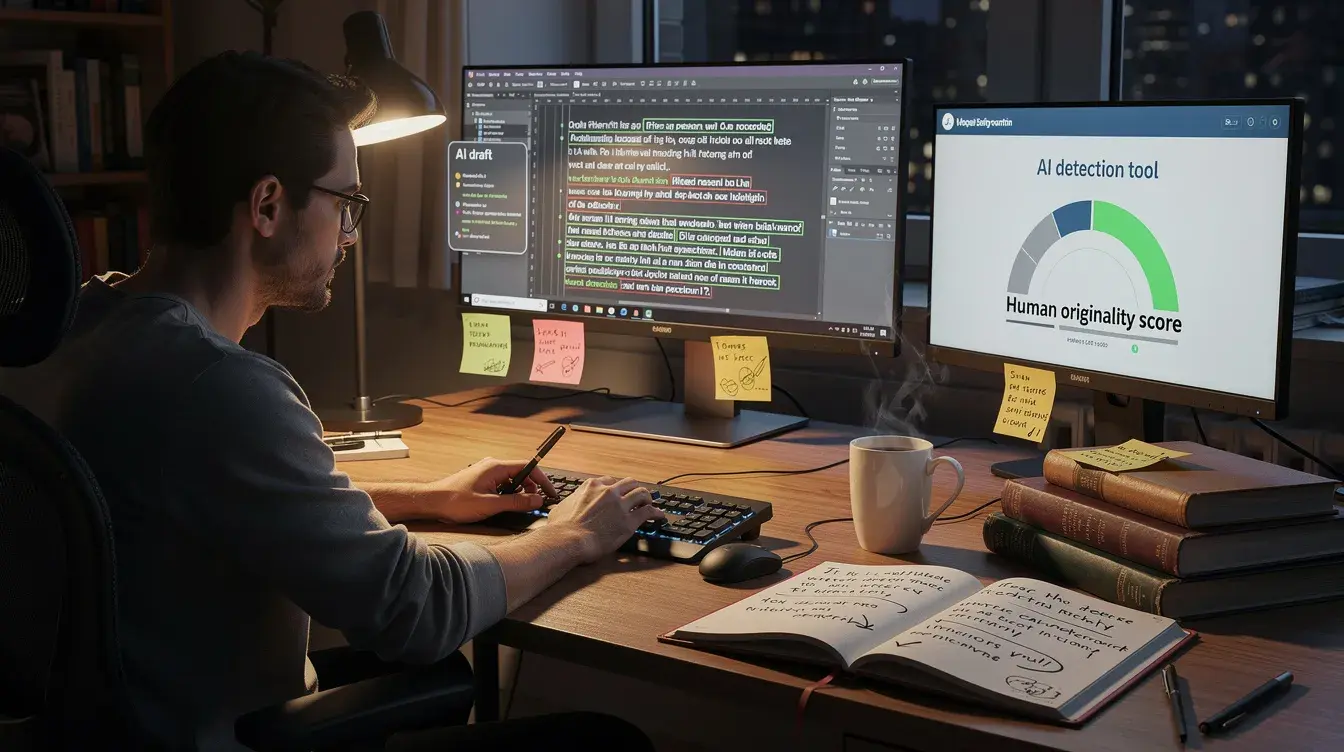
What AI detection tools actually look for
Before you try to avoid AI detection, you need to know what you are up against. AI detection tools do not “see” that a machine wrote something. They estimate it.
Detectors give you a probability, not proof
Every AI content detector reads your text and returns a score, a guess about how likely a machine produced it. That guess leans on statistical patterns, not evidence. The same paragraph can score 12% on one detector and 80% on another. AI detection systems disagree constantly, which tells you how shaky the ground is.
Here is the part vendors bury. In 2023, OpenAI quietly shut down its own AI text detector because it was not accurate enough to trust. The company that builds ChatGPT could not reliably catch ChatGPT, which should reset your expectations for every accuracy claim out there.
The signals detectors watch
AI content detectors run advanced algorithms that compare your draft against human written text and output from large language models. They flag a few tells. Low perplexity, meaning word choices that are too predictable. Low burstiness, meaning sentences of the same length and rhythm. Repetitive phrasing. A uniform structure where every paragraph opens the same way. One of the key features they score is variety. Human writers wander. AI generated writing marches in a straight line, and that regularity is the fingerprint content detectors chase.
Why chasing a 0% AI score is the wrong goal
Quick reality check before you hunt a perfect score. Detectors are wrong often, in both directions.
Turnitin told universities its AI tool had a 1% false positive rate. Vanderbilt did the math and disabled Turnitin’s AI detector in August 2023: across the 75,000 papers it processes a year, even 1% means roughly 750 students wrongly flagged. The false positives are not evenly spread either. A Stanford study found seven detectors flagged the majority of essays by non-native English speakers as AI generated, while barely touching native writers. The cause was low perplexity: simpler, constrained vocabulary reads as “machine” to a detector, even when a real person sweated over every line.
You will also see AI writing tools promising to make AI generated text undetectable, or to render your AI text undetectable in a single click. Be skeptical. The urge to bypass AI detection usually backfires, because the shortcuts that claim to bypass AI checks leave their own robotic fingerprints. Predictable patterns are what make text AI detectable, and no setting hands you the originality AI vendors imply.
So if a detector can call a human student a robot, a green checkmark means very little. The goal is not to fool a flawed machine. It is writing that is genuinely yours. Which brings us to the disclaimer that matters.
This guide is about legitimate use: taking an AI generated draft and making it truly your own, or clearing a false positive on writing you actually wrote. It is not about passing off unedited AI content as your own. If you write in academic and professional settings, follow your institution’s academic integrity policies, and be transparent about how you use AI when asked. Responsible AI is not a slogan here. It is the whole point.
How to avoid AI detection, step by step
Work through these in order. Each step lowers your detection scores and makes the writing better.
Step 1. Treat the AI output as a rough draft
Never paste AI text into a final draft. An AI model is a starting point, nothing more. Read the whole thing first. Delete the paragraphs that say nothing. What is left is your working draft, and the writing process begins.
Step 2. Put your own voice in early
The biggest tell in AI generated text is that it has no personal voice. It sounds like everyone and no one. So add your own voice on the first pass, not as a final polish. State an opinion. Drop in a detail only you would know. When you use AI to draft, make the words sound like a person with a point of view. That is what AI content detectors struggle to fake. Write so your draft does not sound AI generated.
Step 3. Vary your sentence structure
AI generated writing loves a uniform structure. Same shape, over and over. Break it. Mix a three-word sentence against a winding twenty-word one. Vary your sentence length on purpose. This raises burstiness fast, and it is how good human writing reads. Read a paragraph aloud. If it lulls you to sleep, your sentence structure is too even.
Step 4. Trade robotic phrasing for plain words
AI tools reach for the same inflated vocabulary again and again. Swap it out. Use plain words you would say. Cut the connective filler. Where AI wrote a smooth, empty transition, write the blunt version in your own words. Plain natural language beats polished mush, for readers and for slipping past content detectors.
Step 5. Add specific examples only you could write
Generic writing sounds AI generated because it floats above the real world. Anchor it. Add a personal example, a real number, a moment from your own experience. This is contextual blending: mixing the draft with specific detail that no language model could invent for you. Personal examples do double duty: they make the text feel human and give the reader something concrete to hold.
Step 6. Vary how your paragraphs open
Look at how each paragraph opens. If they all start with the subject, or with “The,” you have a pattern a detector loves. Vary your paragraph openings. Start one with a question, another mid-thought. Fragment for effect. The aim is authentic writing that moves the way thinking moves, not the tidy grid an AI model defaults to.
Step 7. Scan with AI detection tools as feedback
Now run your draft through a couple of AI detection tools. The mindset that matters: treat the detection scores as feedback, not a verdict. If a section lights up, do not panic or blindly rephrase every word. Reread it. It is usually the part you edited least, still pure AI output. Fix it by hand.
Step 8. Do a real human edit last
Human editing is the step people skip, and the one that works. Read the whole piece top to bottom, aloud, with autocorrect off so it stops smoothing your voice back into AI tone. Fix the clunky lines. Let a few controlled imperfections stand. Perfectly smooth text reads as AI generated; a little texture reads as human writing. By the final pass, the writing evolved from a machine draft into something that is yours.
A layered workflow that ties it together
Put the steps together and you get a loop. Start with AI-assisted research and a first pass. Rewrite for your own voice. Edit sentence length and sentence structure, add real examples, then scan with content detectors and fix what lights up. The more you run it, the faster it goes, because you are training your own thinking.
Common mistakes that make “humanized” text look automated
Plenty of people try to avoid AI detection and make it worse. Watch for these.
Drowning the text in synonyms
Swapping every third word for a thesaurus pick does not humanize AI text. It creates stilted phrasing that readers and AI content detectors both notice. Rewrite whole thoughts, not individual words.
Keeping the grammar robotically perfect
Flawless, uniform grammar is itself an AI signal. Real human writing has natural variation. You do not need errors, but you do need rhythm and the occasional plain, imperfect sentence.
Leaving out personal context
The most common miss is skipping the personal detail entirely. No anecdote, no opinion, no specifics. Without that, even heavily reworded AI content can still sound generic, and generic is what AI detectors were built to catch. Editing AI assisted content well is its own skill.
What tool can I use to avoid AI detection?
You can do every step by hand, and for short pieces you should. For longer drafts, an AI writing tool can handle the mechanical part: smoothing the repetitive phrasing and predictable structure that detection systems flag, so you spend your time on voice and examples. Plenty of these tools market themselves as completely free, then throttle you after a few checks. The better AI writing tools save real time on tedious edits.
A writing assistant like the Eliten AI Humanizer rewrites AI generated drafts to read more naturally while keeping your original meaning. You paste up to 5,000 characters, pick a style (Casual, Professional, or Academic) and a rewrite level, and it evens out the robotic patterns into natural, human-like content. Two honest caveats. No humanizer can guarantee it beats every detector, so treat the output as an improvement, not a magic bypass. And it is a writing aid, not a way around your school’s or employer’s rules. Use it to make your ideas read clearly, then add your voice and examples yourself.
A quick editing checklist for human writing
Before you call it done, confirm the basics:
- Sentence length varies, short against long.
- Your personal voice shows up in the first few paragraphs.
- At least one specific example or number a machine could not invent.
- Paragraph openings are not all the same shape.
- The whole piece reads in your natural voice, at a natural tone.
- Any detector score came down after real edits, not word-swaps.
If all six are true, you have human writing, not disguised AI output.
Using AI responsibly
One more time, because it matters. These techniques help you use AI responsibly: as a drafting partner whose work you own, edit, and stand behind. Responsible AI use means the ideas and judgment are yours. When you are creating content with AI, the editing is where the value lives. Responsible AI use is not a license to cheat. Cite AI tools when your instructor or editor asks. Keep your drafting history, since a transparent version trail is your best defense against a false positive. And when a policy says disclose, disclose. Critical thinking is the part no tool replaces, and it is the part that makes writing worth reading.
Key takeaways
The one conclusion AI detection researchers reach: no score is proof. Detection systems are probabilistic, they disagree, and they punish plain writing. So use AI as a drafting partner, then make the work yours.
- Treat AI tools as a first draft, never a final one.
- Put your own voice and real examples in early.
- Vary sentence structure so the rhythm reads like human writing.
- Run AI detection tools for feedback, then fix flagged parts by hand.
- Use AI responsibly: follow the rules where you write, and disclose when asked.
Responsible AI comes down to critical thinking and human editing. AI tools draft; you decide. That is what makes writing worth reading, and what no detector can measure.
Frequently asked questions
There is no button that makes AI writing 100% human, and anyone selling that is overpromising. What you can do is genuinely rewrite the draft: your own voice, varied sentence structure, real examples, a human edit at the end. Done well, it reads as yours, because by then it mostly is.
A 0% score is possible but never guaranteed, because detection is probabilistic. Turnitin itself is tuned to under-report rather than risk false positives, and it will not score very short passages at all. Genuinely human writing, or an AI draft you rewrote heavily with your own detail, tends to score low. Chasing a literal zero is the wrong target. Writing that is actually yours is the right one.
No AI detector is reliable enough to treat as proof. Accuracy claims are self-reported and swing wildly on real text, which is why OpenAI retired its own AI detector and several universities switched theirs off. Use AI detection tools as a rough signal to find weak sections, never as the final word on whether writing is human.
Light paraphrasing helps a little and fails often. Swapping words while keeping the same robotic sentence structure leaves the exact pattern AI detectors watch for. To actually avoid detection, change the structure and add real substance, not just the vocabulary.
It depends entirely on your setting. Many workplaces and schools allow AI use with disclosure; others restrict it. Check your academic integrity policies or company guidance, use AI within them, and be transparent when asked. The tool is not the problem. Misrepresenting who did the work is.
Sources
- OpenAI shut down its own AI text detector over low accuracy, TechCrunch (2023): https://techcrunch.com/2023/07/25/openai-scuttles-ai-written-text-detector-over-low-rate-of-accuracy
- Vanderbilt University, Guidance on AI Detection and Why We’re Disabling Turnitin’s AI Detector (2023): https://www.vanderbilt.edu/brightspace/2023/08/16/guidance-on-ai-detection-and-why-were-disabling-turnitins-ai-detector/
- Liang et al., GPT Detectors Are Biased Against Non-Native English Writers, Patterns / Cell Press (2023): https://www.sciencedirect.com/science/article/pii/S2666389923001307